
Film Movement Context
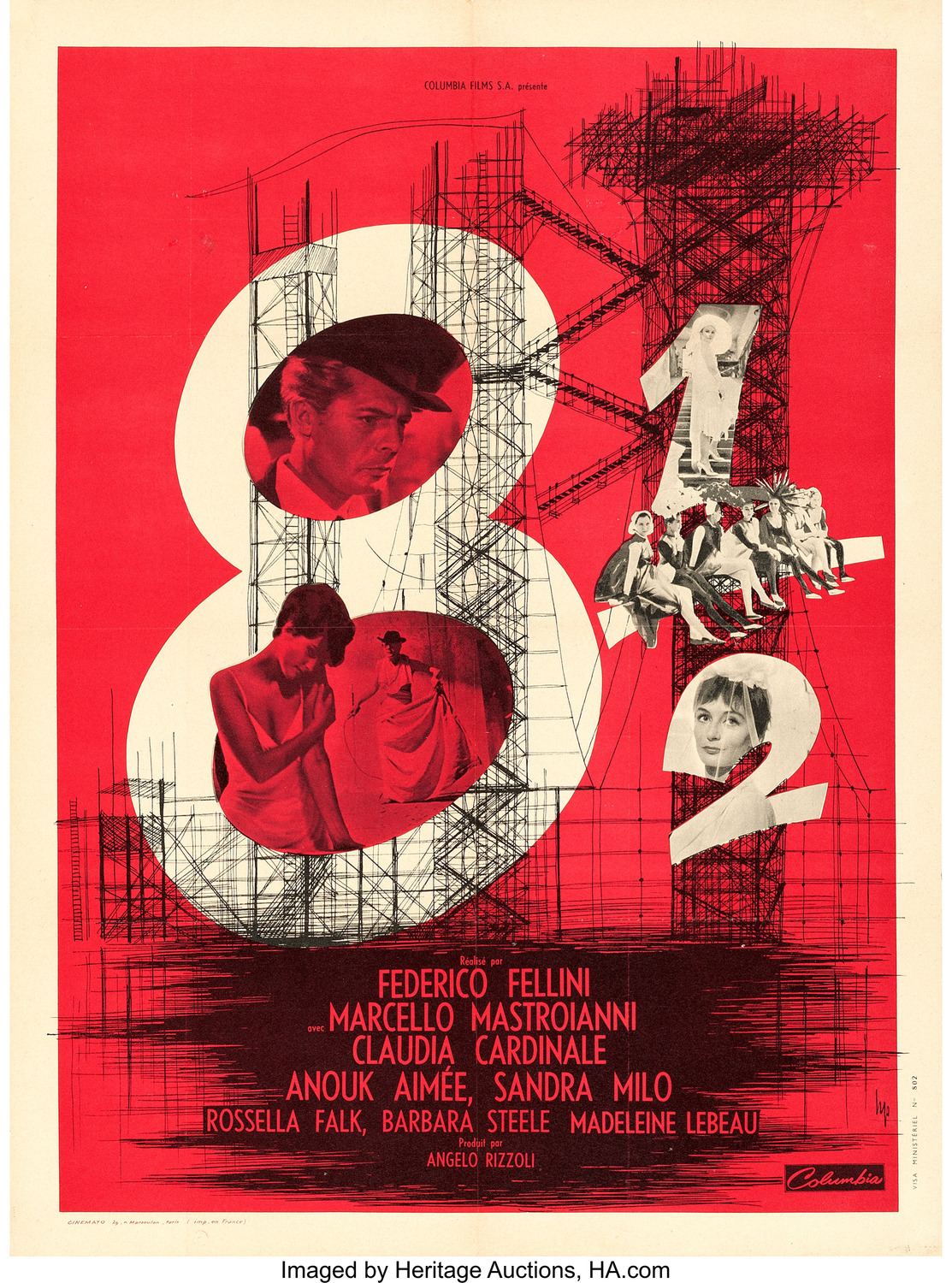
Federico Fellini’s 8½ (1963) is most closely associated with the Italian art cinema movement that blossomed in the late 1950s and 1960s, particularly Italian modernism, as well as the larger European Modernist and Auteurist traditions. While it is a product of Italian cinema and draws from the earlier Italian Neorealism, 8½ marks an evolutionary step towards modernist filmmaking characterized by self-reflexivity, narrative experimentation, and psychological depth. It is widely celebrated as a quintessential work of auteur cinema—a film shaped by the distinct personal vision of its director—and serves as a cornerstone of the European Art Film movement. This movement, unlike classical Hollywood, prioritizes personal expression, ambiguity, and the breaking of conventional narrative structures. Thus, 8½ not only belongs to Italian and European modernism, but is also integral to the global art cinema tradition for its daring engagement with the nature of creativity, identity, and cinema itself.
Historical Origins of the Movement
The roots of the art cinema and European modernist film movements lie partly in the devastation of World War II and the cultural, political, and social upheavals that followed. In Italy, the immediate postwar years saw the emergence of Neorealism, with directors such as Roberto Rossellini, Vittorio De Sica, and Luchino Visconti focusing on stories about ordinary people, shot on location using nonprofessional actors and natural lighting. This movement was a response to the horrors of war, Fascism’s collapse, and a disillusionment with escapist studio productions. Neorealism’s commitment to social reality and authenticity, however, would gradually give way to greater introspection and formal experimentation as Italy entered a period of economic growth (the “economic miracle”) in the 1950s and 1960s.
Simultaneously, across Europe, a new generation of filmmakers embraced modernist ideas borrowed from literature, painting, and philosophy, confronting existential and psychological issues and fragmenting classical narrative conventions. This was a time of artistic flourishing in France (the Nouvelle Vague), Sweden (with Ingmar Bergman), and beyond. Italian directors such as Michelangelo Antonioni and Federico Fellini began moving away from Neorealism’s exterior gaze towards interior worlds. They experimented with disjointed timelines, ambiguity, and metafictional elements reflecting the uncertainty and alienation of modern life. These trends coalesced in the European Art Film movement, which found support at international film festivals, art houses, and among intellectual audiences seeking films that engaged with issues of identity, subjectivity, and the complexity of contemporary existence.
This Film’s Contribution to the Movement
8½ is a defining artifact of the modernist and art cinema traditions because it radically reimagines what film could be—moving away from linear, cause-and-effect plotting and instead portraying the tormented inner life of its protagonist, filmmaker Guido Anselmi (played by Marcello Mastroianni). Fellini uses non-linear structure, complex flashbacks, dream sequences, and overt meta-cinematic references to blur the boundaries between reality, imagination, memory, and creativity. This self-reflexivity—the idea of a film being about itself as a film, and its maker—epitomizes modernist practice and signals a deep engagement with the artistic process itself.
Formally, 8½ is characterized by fluid and expressive camerawork, stylized mise-en-scène, and an innovative use of sound and music—strategies that invite the audience to experience Guido’s psychological fragmentation and creative paralysis firsthand. The film’s narrative eschews clear resolution or conventional character arcs, instead immersing the viewer in a stream-of-consciousness journey. It explores the crises of artistic identity, the conflicts between public and private life, and the elusiveness of inspiration, making the filmmaking process itself both subject and structure.
Crucially, Fellini’s position as the “auteur” of 8½—his creative presence felt in every frame—cements the film’s place as a touchstone for authorial expression in cinema. The title itself, referencing Fellini’s prior films (eight features and one short, counting as “halves”), playfully acknowledges this self-referentiality. In so doing, 8½ not only embodies the modernist and art cinema movements, but also provides a meta-commentary on them, simultaneously celebrating and problematizing the director’s personal vision. Its synthesis of autobiography, fantasy, and cinema as self-interrogation marks a profound shift away from mere story-telling towards cinema as philosophical and aesthetic exploration.
Influence on Later Genres and Films
- Postmodern Cinema and Meta-Narratives –
8½ helped lay the groundwork for postmodernist film by deconstructing the relationship between fiction and reality, artist and artwork. Later directors such as Woody Allen (Stardust Memories), Bob Fosse (All That Jazz), and Charlie Kaufman (Synecdoche, New York) explicitly referenced or were deeply influenced by Fellini’s blending of life and art, as well as his use of the unreliable, self-questioning protagonist. The film’s meta-narrative framework—where the process of making art is as important as the artwork itself—became a key feature of many late twentieth-century and contemporary films, including those that interrogate their own medium or break the fourth wall. - Shaping the Auteur Theory and Global Art Cinema –
8½ and its contemporaries provided inspiration and validation for the auteur theory, which emphasizes the director as the primary creative force in filmmaking—an idea championed by French critics and later adopted globally. Its success increased support for director-driven, personal filmmaking in Europe, the Americas, and Asia. Directors from François Truffaut and Ingmar Bergman to Martin Scorsese, Pedro Almodóvar, and Satyajit Ray have cited 8½ as fundamental to their understanding of film as a medium for personal exploration, thus shaping the expectations and ambitions of art cinema worldwide. - Narrative and Formal Experimentation in Mainstream and Independent Film –
By popularizing nonlinear storytelling, dream logic, and ambiguous narratives, 8½ encouraged both mainstream and independent filmmakers to break away from the three-act structure and experiment with form. This legacy is visible in works like David Lynch’s Mulholland Drive and Michel Gondry’s Eternal Sunshine of the Spotless Mind, both of which build on Fellini’s fusion of subjective experience, memory, and fantasy. Even outside the context of “art cinema,” the willingness to play with time, consciousness, and self-reference in contemporary film traces back to Fellini’s innovations.
The Movement’s Lasting Impact
The modernist and art cinema movement that produced 8½ continues to resonate because it permanently expanded the possibilities of cinematic language and content. The movement questioned and transcended traditional boundaries of storytelling and representation, inviting audiences and filmmakers alike to recognize film not only as entertainment, but as a medium for intellectual inquiry, artistic experimentation, and the exploration of personal and collective anxieties.
Modernist cinema’s legacy remains vital in several respects. First, it established new paradigms for narrative and visual structure, normalizing ambiguity, subjectivity, and metafictional play in global cinematic practice. Second, it affirmed the legitimacy and importance of the director’s personal voice, inspiring ongoing debates about creativity, authorship, and the status of cinema as art. Third, films like 8½ demonstrated that movies could reflect on their own creation and the state of their medium, generating a tradition of reflexive and self-aware filmmaking that remains influential in both art and popular contexts.
Finally, by opening up film to questions of identity, memory, and the limits of self-knowledge, the movement remains attuned to the complex realities and uncertainties of contemporary life. As audiences continue to grapple with questions of authenticity, subjectivity, and the nature of artistic creation, the relevance of modernist and art cinema as exemplified by 8½ endures, ensuring that cinema remains a living, evolving art form.