
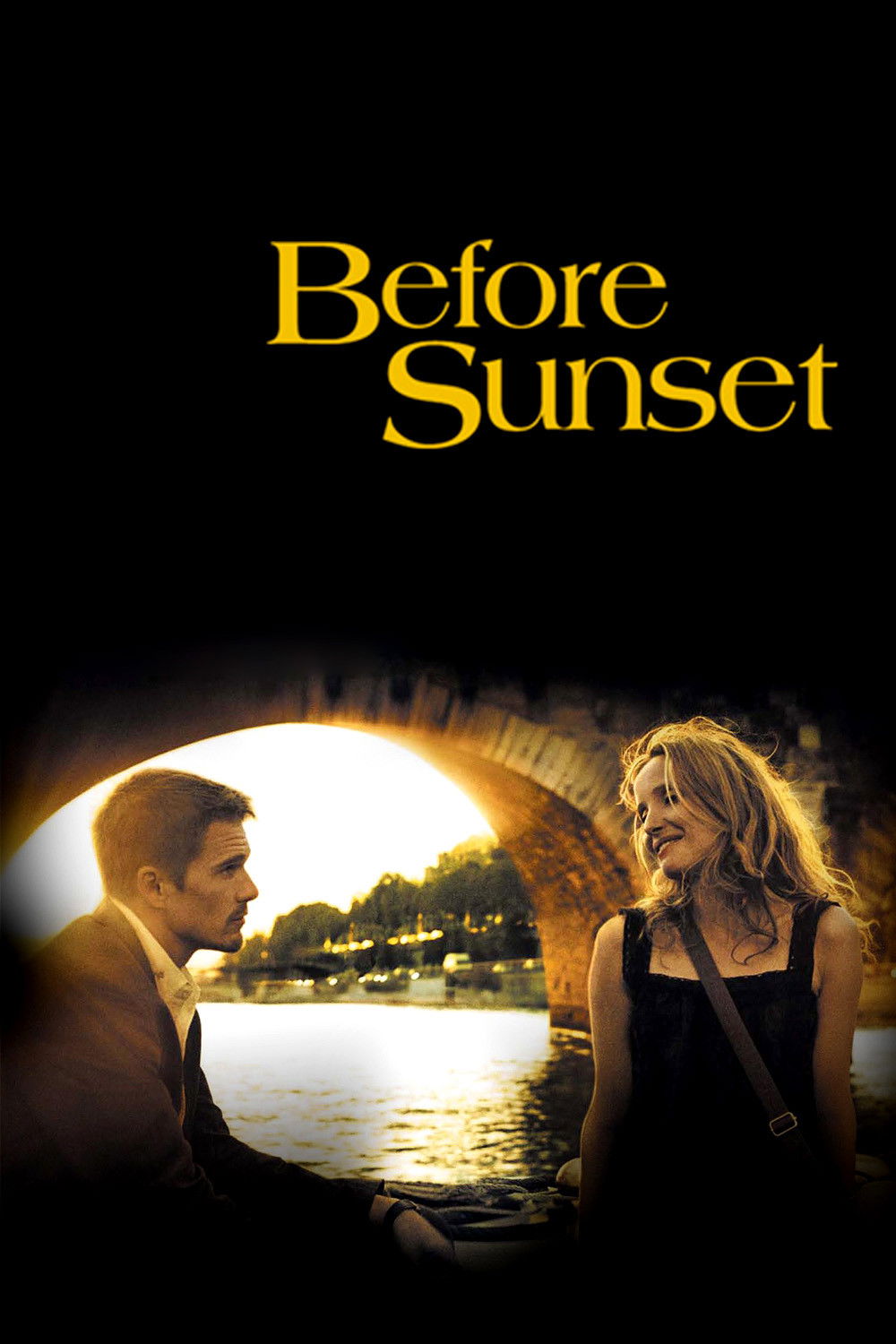
Film Movement Context
Whenever I return to Before Sunset, I find myself swept up not only by its poignant depiction of fleeting connection but also by its profound alignment with a very particular strand of European—and especially French—cinematic tradition. While it’s tempting to see the film purely as a romantic drama or even a highly intellectual “talk movie,” I’ve always felt most compelled to frame it within the legacy of the so-called “Second Wave” art-house realism. More specifically, the film embodies the ethos of the “cinéma du corps” (cinema of the body) and the broader post-French New Wave sensibilities that flourished in the 1990s and early 2000s. Rather than positioning itself within the bruised irony of American indie realism or a nostalgia for classical Hollywood geometry, Richard Linklater’s approach absorbs the conversations, physical presence, and narrative looseness that I associate with the waking life of New Wave auteurs like Éric Rohmer and Agnès Varda. For me, the film’s dedication to unstructured time, open dialogue, and the rejection of traditional plot signposts marks it not merely as a revival but as a meditation on art-house walking-and-talking cinema—what I’d call the “intimate realism” movement.
Historical Origins of the Movement
Tracing the lineage of intimate realism leads me directly back to post-war European cinema, which was, in itself, a restless response to both commercial studio constraints and a world recalibrating after unprecedented turmoil. Directors like Rohmer, Godard, and Varda in the 1960s began to distrust the artificiality of tightly plotted dramas and instead favored slices of life—conversations, chance encounters, everyday settings—that felt as unpredictable as actual human experience. Initially, this wasn’t about handheld cameras or jump cuts alone but about liberating characters from storytelling conventions, letting them breathe, walk, muse, and repeat themselves as real people do. As I see it, the arrival of this movement was a kind of cinematic democratization. It rejected the grand narratives and polished exteriors of classic Hollywood in favor of banality, uncertainty, and flawed emotional landscapes. It thrived in a climate hungry for authenticity, personal voice, and the poetry of daily life. When 1990s and 2000s American directors picked up these tools, especially with an admiration for European art films, that spirit migrated and evolved, with Linklater standing among those most adept at channeling its possibilities for a new era.
This Film’s Contribution to the Movement
Watching Before Sunset, I couldn’t help but feel that I was experiencing the movement stripped to its emotional core. Instead of manufactured plot twists, Linklater constructs meaning through temporal constraint: the entire film unfolds in near real-time, chronicling just over an hour of two former lovers’ reminiscences and meanderings on the streets of Paris. The evocative simplicity of this approach struck me as a feedback loop to the radical experiments in narrative minimalism that earlier French directors had championed. Linklater, Ethan Hawke, and Julie Delpy (whose contributions to the script are impossible to overstate) take the “cinéma du corps” mandate seriously; the camera lingers as bodies shift, eyes flicker, and memories press against the boundaries of the present. I never felt forced into identifying with Jesse or Céline through cinematic manipulation; instead, I was invited to notice the spaces between their words, the subtle choreography of regret and hope, and the fragile truth of reunion. There’s a palpable commitment to embracing silences, hesitations, and the anxiety of time running out. For me, the film’s reluctance to spoon-feed meaning is its greatest strength: it trusts conversation, routine, and fragmented memory as dramatic forms, which is precisely the hallmark of intimate realism. In this, Before Sunset becomes both a tribute to and an expansion of the movement, demonstrating that emotional intensity does not require narrative grandstanding, only honest observation.
Influence on Later Genres and Films
- Influence 1 – I’ve seen a clear revitalization of directorial focus on conversational realism, not only in Linklater’s own later work but in films like Andrew Haigh’s Weekend and Mia Hansen-Løve’s Things to Come. They seem to inherit Linklater’s faith that a camera can sustain tension and emotional resonance by dwelling on talk, hesitation, and unscripted accidents, rather than relying on high-drama plot mechanisms. I interpret this as a direct outgrowth of what I witnessed in Before Sunset: a patience with ambiguity and the courage to let romance be not a narrative arc, but a space for shared uncertainty.
- Influence 2 – The stylistic intimacy of Before Sunset forever altered how I think about the “walk and talk” genre itself. Its seamless blending of urban landscape and unfolding emotion sharpened my appreciation for later films and series that treat cities as living, breathing characters. For instance, I often draw a line from Linklater’s Parisian wanderings to the confessional, unhurried pacing of shows like Normal People, where the architecture of encounter becomes as important as what’s spoken aloud. The movement gave later creators the permission to trade size for specificity, fashioning drama out of two people moving through space and time together.
- Influence 3 – I am convinced that Before Sunset’s approach to time—in which the narrative duration aligns almost perfectly with real clock time—has nudged a wave of filmmakers to experiment with temporality. This is especially noticeable in single-location, compressed-time stories, from Sebastián Lelio’s Gloria to Cristian Mungiu’s 4 Months, 3 Weeks and 2 Days. The absence of ellipses or cinematic cheats forces both character and viewer to confront the immediacy of emotion and dialogue; it resists closure and, instead, exposes the ache of possibility. I see these attempts as direct reverberations of the intimate realism playbook that Before Sunset so confidently broadcasts.
The Movement’s Lasting Impact
Each time I revisit what I call intimate realism, I am reminded why its impact endures and why, for films like Before Sunset, its importance only grows with age. In our current media landscape, where stimuli abound and emotional surfaces are often flattened for efficiency, returning to a movement that privileges the messy, inarticulate, and inconclusive feels almost like an act of resistance. For me, the greatest gift of this cinematic ethos is its faith that attentive observation—of gesture, silence, or a glance—matters as much as plot machination or spectacle. The movement’s legacy persists in giving voice to doubt, memory, and the necessity of human connection in all its contingent fragility. I believe that as viewers continue searching for authenticity, complexity, and avenues for empathy, the lessons of this tradition—embodied so gorgeously in Before Sunset—will remain urgently relevant, reminding me to look closer, listen harder, and value the intricate ballet of the everyday.
To connect style and technique with broader context, you may find these perspectives useful.
🎬 Check out today's best-selling movies on Amazon!
View Deals on Amazon