
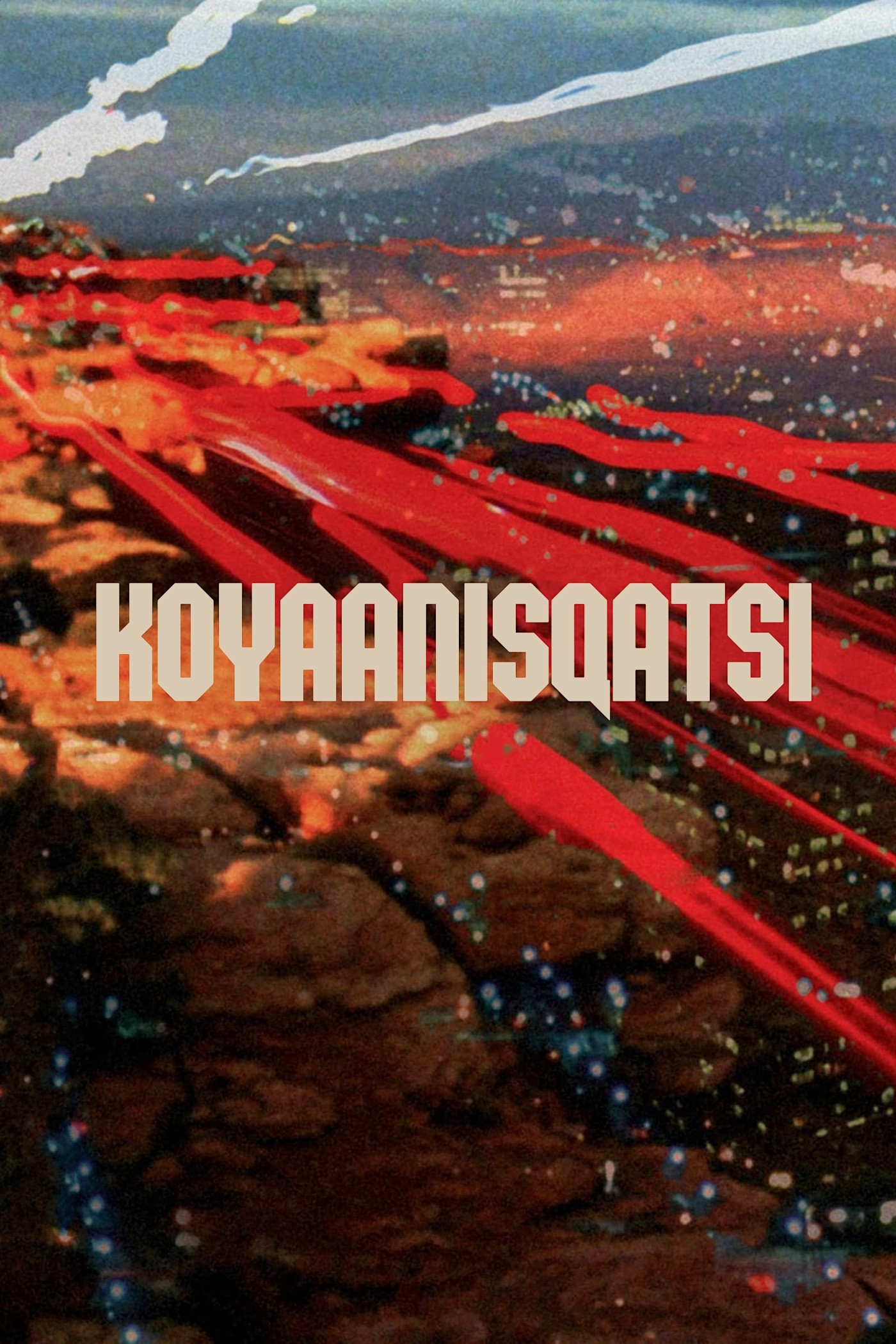
The Genre of This Film
When I first encountered Koyaanisqatsi, I immediately felt that I wasn’t just watching a movie, but immersing myself in the purest form of a documentary—yet it was unlike any other documentary I’d experienced. For me, this film is best described as an “experimental documentary” or, to be even more precise, a “non-narrative visual essay.” It resists the traditional conventions that I often associate with either narrative cinema or standard documentaries. Instead, what I witnessed felt like an avant-garde meditation—an extended collage of images and sounds designed not to tell a story in the usual sense, but to evoke a unique state of mind and reflection on modernity. While some critics have attempted to label it as a pseudo-documentary, I am convinced that its core identity is as a poetic, sensory-driven documentary that relies completely on imagery, music, and montage instead of dialogue, narration, or conventional plot. This approach, to my mind, is the heart and soul of the non-narrative documentary—a genre that privileges visual experience, abstract argument, and emotional resonance over facts, talking heads, or linear storytelling.
Key Characteristics of the Genre
- Common themes
- Typical visual style
- Narrative structure
- Character archetypes
In my view, the major themes that define non-narrative and experimental documentaries revolve around the concepts of time, change, and humanity’s relationship with the world. I notice how these films often explore patterns of modern life, transformations in nature, technology’s grip on daily experience, or the tension between the organic and the artificial. Personal perception plays a key role—they seem to ask me, as a viewer, to re-think the ordinary by seeing it through a carefully constructed lens. There’s nearly always a fascination with process, motion, and cycles—not just events and outcomes. Rather than preaching a specific message, these films let the audience draw their own conclusions, using sensory immersion as a prompt for meditation on larger issues. I see environmental awareness as another recurring thread, along with a quiet critique (sometimes subtle, sometimes sharp) of technological progress or urban expansion.
I’m always struck by the daring cinematography at the core of this genre—long, unbroken shots, time-lapse sequences, or hyper-accelerated photography are practically its trademarks. Experimental documentaries like Koyaanisqatsi favor grand vistas, abstract close-ups, and unusual camera angles, all designed to uncouple the viewer from the familiar. I feel the visual style is often wordless, opting for montage and rhythmic editing as its forms of communication. There’s generally a strong aesthetic drive, with an emphasis on composition, color contrasts, and visual texture. Sometimes the visuals are paired with arresting, original scores that emphasize mood and flow. Common images range from natural landscapes to crowded cityscapes, always seeking to draw connections between disparate visual elements through parallelism and juxtaposition.
What stands out most to me about the genre’s approach to structure is its remarkable freedom from story. While feature documentaries often use narrative arcs or argumentation, non-narrative documentaries abandon these templates altogether. Instead, I encounter a mosaic structure: images are grouped into thematic sequences, often without chronological order or causality. Sometimes, the film is divided by movements or sections, each focusing on a motif—time, place, or idea—without concern for characters or plot. There’s repetition, especially in how motifs or visual metaphors are built up over time. The rhythm is dictated by editing and musical cues rather than story beats. Watching these films is more akin to listening to a concept album or wandering through a gallery than following a story from point A to point B.
Character, as I traditionally understand it, is almost always absent in this genre. When people appear, they’re rarely differentiated as individuals—instead, they’re part of a collective presence or serve as ciphers within the landscape. Faces may be shown in close-up, but seldom given a name or narrative context. It is as if humanity becomes a motif or emblem, placed on equal footing with machines, city grids, clouds, or surging rivers. Because of this tendency, I find myself observing people as part of the visual tapestry rather than as agents in a dramatic story. Occasionally, the “protagonist” feels like the planet, the passage of time, or even technology itself. In the absence of dialogue or traditional characterization, the film’s “voice” is the interplay between imagery, music, and theme.
How This Film Exemplifies the Genre
The first time I watched Koyaanisqatsi, it was immediately clear to me just how deeply the film embodied every distinctive trait of the non-narrative documentary. The absence of spoken words startled me; I’d come to expect at least a veneer of explanation in documentaries. Here, all I received was a sweeping visual journey—city to desert, microchip to mountain, faces to freeways—stitched together by Godfrey Reggio’s astonishing direction and Philip Glass’s relentless, minimalist score. For me, the film doesn’t so much address me as challenge me to construct my own meaning from the relentless barrage of imagery. There are no captions or on-screen identifiers. Instead, I see extended time-lapse photography and slow-motion sequences deployed not for spectacle, but as meditative tools. The city’s pulse becomes heightened, the movements of crowds unnervingly mechanical. The grandeur of nature and the frenetic energy of industrialized civilization stand in direct counterpoint, raising the question (in my experience, almost wordlessly): what has happened to the world, and what is our place in it?
Visually, Koyaanisqatsi delivers what I consider the gold standard in non-narrative cinema. I still remember those breathtaking transitions between natural wilderness and teeming urban centers; the way smoke billows, traffic streams, and faces blur into visual symphonies of sameness and difference. Every decision—the framing, the use of negative space, the alternation between macro and micro scales—serves to draw connections that aren’t spelled out but deeply felt. The soundtrack isn’t just an accompaniment; in many moments, it’s the driving force sculpting my emotional response. There is a sense that I am being steered not by story, but by syncopation, by the hypnotic repetition and variation of sound and vision.
In terms of structure, my experience has always been that the film flows like a river with no predetermined mouth. It moves through loosely-connected movements, each evoking a different aspect of the tension between nature and technology. There’s no overt message, no moral voiced by any narrator. Instead, I’m left with impressions—juxtapositions, crescendos, moments of beauty and distress, acceleration and calm. The lack of character makes every crowd both anonymous and emblematic. People become motifs, flickering in and out of the landscape, as integral and objective as shadows or geometric patterns. I’ve often found myself transfixed, less by stories or characters than the sheer force of observation itself. For me, Koyaanisqatsi doesn’t just belong to the experimental documentary tradition—it establishes its own benchmark for what can be achieved in the genre through image, sound, and pace alone.
Other Essential Films in This Genre
- Man with a Movie Camera (1929) – Dziga Vertov’s City Symphony
Whenever I think about where the non-narrative documentary truly began, Vertov’s Man with a Movie Camera leaps to mind. The first time I saw it, I was swept up in a dizzying celebration of Soviet urban life; the film abandoned scripted dialogue and characters, opting instead for a day-in-the-life depiction of a modern city. What engrossed me wasn’t plot, but the ballet of editing: jump cuts, double exposures, split screens, and every possible camera trick then available. For me, it’s not just foundational to the genre, it practically defines it—an exuberant experiment where editing itself is the protagonist and daily reality becomes a living, pulsating organism.
- Baraka (1992) – Global Visual Meditation
Watching Baraka for the first time was an overwhelming, almost spiritual experience. Like Koyaanisqatsi, the film dispenses with dialogue, narration, and characterization, offering instead a global survey of rituals, nature, and city life. What I find particularly distinctive here is the global reach: from Tibetan monasteries to bustling Tokyo intersections, the film threads together humanity’s spiritual and material footprints in one unbroken tapestry. The slow, patient editing and haunting music compel me to reflect—visually and emotionally—on the interconnectedness, beauty, and sometimes devastation of life on Earth.
- Samsara (2011) – Visual Continuation and Expansion
I personally consider Samsara a spiritual successor to both Koyaanisqatsi and Baraka. From the first minutes, I was mesmerized by the high-definition cinematography and the way it floats across geographies, time periods, and cultures without a single word. The beauty and horror of the modern world are juxtaposed with ancient rituals, machine assembly lines, and natural wonders, all edited into mesmerizing sequences. To me, this film represents the full maturation of the genre, exploiting new technologies for image capture and color correction, but remaining utterly devoted to wordless observation and visual poetry.
- Visitors (2013) – Human Face as Visual Landscape
Reggio’s Visitors left a profound impression on me as it turned the non-narrative lens back onto the human face itself. Here, the focus is largely on portraiture—slow-moving, extreme close-ups that transform ordinary human expression into abstract art. Time seems to elongate as I engage with the minute shifts in emotion and perception, paired with Philip Glass’s haunting score. The absence of context or explanation draws my attention to the universality and ambiguity of the human gaze. For me, Visitors demonstrates the genre’s boundless versatility and its ability to provoke empathy without a single spoken word.
Why This Genre Continues to Endure
Whenever I revisit films like Koyaanisqatsi or introduce friends to this genre, I’m always fascinated (and frankly, a little surprised) by how powerfully these experimental documentaries resonate—decades after their creation. I think, at its core, this genre endures because it offers something that no other form of cinema does: the chance to step outside the boundaries of story and character and instead experience an overwhelming sense of the world’s patterns, contradictions, and beauty.
In my experience, audiences are drawn to these films much like people are drawn to meditation or abstract painting. The hunger for meaning persists, but meaning is felt rather than explained or argued. The visual grammar rewrites the rules: it is interpretation, provocation, and revelation all at once. Modern viewers—faced with relentless narrative content in every medium—find something deeply revitalizing in a film that lets images breathe, that dares to sustain a single shot or motion for twice as long as expected.
I have noticed that younger generations, raised on the quick cuts and algorithmic recommendations of digital streaming, can find these films jarring at first, but later deeply soothing or illuminating. The absence of spoken exposition requires a kind of active, contemplative watching—a skill that feels increasingly rare. Yet the reward is potent: a renewed attentiveness to pattern, process, and the sheer strangeness of ordinary experience. There’s also the perennial relevance of the themes—environmental degradation, technology’s omnipresence, the global sameness of urban experience—all of which have only grown more urgent since the earliest city symphonies.
For me, the non-narrative documentary remains essential precisely because it dares to ask viewers not just to watch passively, but to participate in making sense of the world. Its images linger, returning in dreams or moments of reverie, encouraging reflection long after the credits roll. In that sense, I see its endurance as a testament to our ongoing need to reimagine our world—not through words, but through the mesmerism of pure sight and sound.
If you’re interested in how viewers respond beyond technique, you may want to explore audience and critical reception.
🎬 Check out today's best-selling movies on Amazon!
View Deals on Amazon