
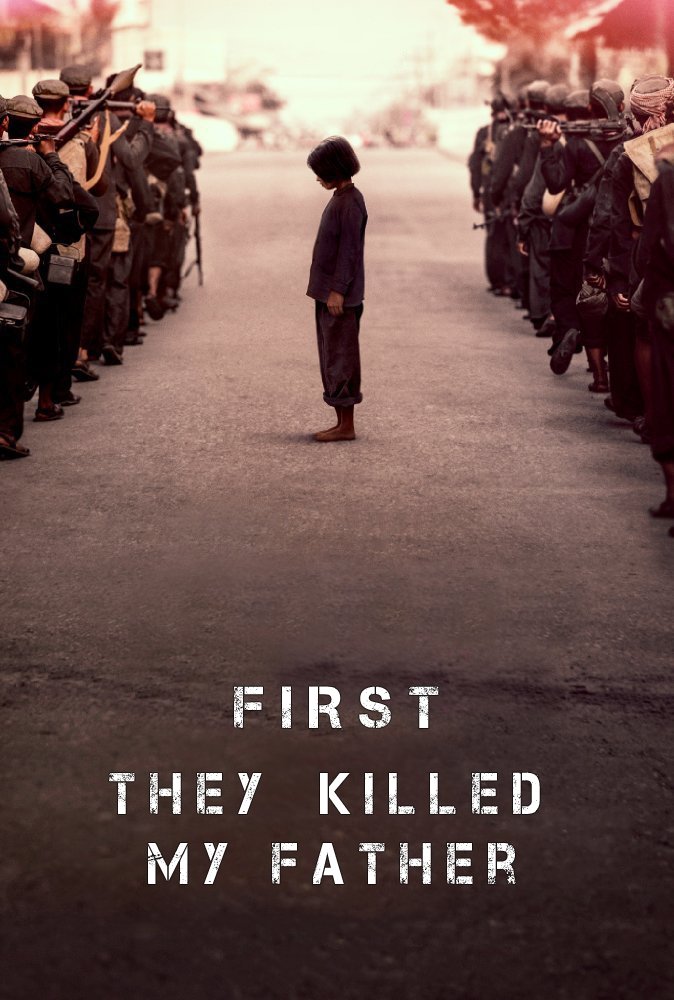
Film Movement Context
Few films have haunted me as persistently as First They Killed My Father, and I find its power lies in more than its narrative or visuals—it stems from its deep embedding within the transnational realist movement and, more specifically, the modern wave of postcolonial and testimonial cinema. When I reflect back on my experience with this film, I’m struck by how it seems to belong to a particular lineage: films that are grounded in lived trauma, constructed from firsthand testimony, and dedicated to portraying national histories long silenced by mainstream global cinema. I’ve seen movies that seek to represent atrocity with clarity and urgency, but for me, this film takes its place among the school of contemporary testimonial realism—a movement that channels neorealist aesthetics, but broadens its scope to transnational stories shaped by the reverberations of imperial histories, genocide, and memory work.
What makes First They Killed My Father particularly significant in my eyes is its marriage of the firsthand, subjective voice—anchored in Loung Ung’s personal story—with an intense, immersive visual style. This roots it firmly alongside the likes of the Latin American “third cinema,” Southeast Asian new wave, and the postcolonial realist movement. I felt this film challenging boundaries, resisting both Hollywood spectacle and the cold detachment of some Eurocentric arthouse. In that sense, it clearly participates in an ongoing evolution where survivor testimony is not just recounted but viscerally re-experienced by the audience. I see in it the unmistakable marks of postcolonial cinema: the foregrounding of indigenous perspectives, the rejection of Western “outsider” narratives, and the ethical dilemma of representing trauma without exploiting it.
Historical Origins of the Movement
Whenever I trace the roots of testimonial realism and the broader current of postcolonial cinema, I’m aware I’m following the contours of twentieth century history: war, revolution, decolonization. The story starts, for me, with the Italian neorealist revolution of the 1940s—a movement born of necessity, with filmmakers emerging from the wreckage of World War II to capture everyday life amidst political and social upheaval. Watching those early neorealist films, I sense the urgency to bear witness, to resist escapism, to place the camera at ground level. These elements resonated far beyond Italy, giving birth to movements like third cinema in Latin America, the “parallel cinema” of India, and the militant works of African postcolonial directors.
What differentiates postcolonial testimonial cinema, as I perceive it, is its particular insistence on personal memory as historical evidence. This became more pronounced in the late twentieth century when survivors of genocide, civil war, and systemic oppression began telling their stories—often in collaboration with or as filmmakers. I see this as an evolution from social realism to personal realism, a shift catalyzed by the failures of both totalitarian regimes and imperial interventions to acknowledge the truth of the colonized or oppressed. I’m reminded of Rithy Panh’s Cambodian documentaries or the testimonial films of Patricio Guzmán from Chile: these works are built not from a distance, but from within the trauma itself.
The logic of these movements reflects my own growing suspicion of images and testimonies mediated through institutions of power. Instead, I value the insistence on lived experience as both method and subject. By the twenty-first century, postcolonial testimonial cinema had fused digital accessibility with a globalized urgency for historical redress, making space for voices rarely heard within the old canons of Western cinema. First They Killed My Father emerges, for me, from this specific crucible—staking its claim in a tradition that values memory as its own form of resistance, and visual storytelling as a way to carve out a new archive of collective and individual histories.
This Film’s Contribution to the Movement
Some movies, I feel, simply reproduce the conventions of their chosen genre or movement, but First They Killed My Father stands out through its formal innovation and ethical rigor. What strikes me most is the film’s commitment to subjective immersion: the technical choice to shoot at Loung Ung’s eye level, frequently framing the horror around her, not as spectacle, but as a child’s incomprehensible reality. For me, this aligns perfectly with the testimonial realism I described above. There’s an anti-didactic quality to the film, a principled refusal to flatten trauma into tidy lessons or explanatory voiceovers. Instead, director Angelina Jolie and co-writer Loung Ung render the experience with an immediacy that I associate with the best of memory-work cinema—moments are fragmentary, the sensorial details heightened, and much is left unsaid, echoing the silences at the heart of atrocity.
In my view, the film advances postcolonial realism by rejecting Western gazes and priorities. Rather than filtering the Khmer Rouge era through the lens of foreign intervention or humanitarian rescue, the film centers Cambodian children—actors, crew, and language. Watching it, I’m reminded of the Cambodian tradition of oral storytelling, of memory passed through generations, but now updated for the screen as a communal act of witness. It’s important for me that the cast and production crew involved local Cambodian talent and worked directly with survivors; this is not just stylistic authenticity but an ethical choice embedded in the very process of making the film.
I’m also fascinated by how the film structures its narrative time. There’s a deliberate refusal to universalize or sentimentalize trauma. Instead, I feel thrown into Loung’s subjectivity—her confusion, her truncated memories, her determination to survive. The camera lingers not only on atrocities but also on small gestures: a family meal interrupted, a quiet moment of play, the intricacies of traditional mourning rituals. In this layering of collective and individual experience, I see a new dimension for testimonial realism—one that eschews closure, privileging the tension between memory and history, survivor subjectivity and communal loss. By refusing narrative catharsis and easy redemption, the film honors the complexity of Cambodian experience and broadens the possibilities for postcolonial cinema to do justice to its subjects.
Influence on Later Genres and Films
- Ethical Witnessing in Global Cinema – For me, one of the film’s most significant legacies is its effect on how later dramas approach the ethics of witnessing trauma. I’ve watched an increasing number of films—be they from Eastern Europe, Africa, or Latin America—emphasizing the necessity of collaborating with survivors and local communities, or sharing authorship with those whose stories are represented onscreen. First They Killed My Father seems to mark a shift: no longer can trauma films rely on Western narrators or explicit explication. Instead, I see a growing trend of films using immersion and subjective camerawork as ways to confront rather than aestheticize atrocity, such as in recent works by Chaitanya Tamhane or Mati Diop.
- Hybridization of Genre and Style – Personally, I see in this film a blending of genres—melding war drama, testimonial narrative, and coming-of-age elements. This hybrid approach influences how emerging filmmakers mix documentary and fiction, using realism not as a strict set of rules but as an adaptable toolbox. For instance, some Southeast Asian and African directors now experiment with non-linear storytelling, child’s-eye perspectives, or diegetic soundscapes to create films that destabilize viewers’ expectations. I point to works like Sivaroj Kongsakul’s Eternity or Amjad Abu Alala’s You Will Die at Twenty as beneficiaries of this stylistic fluidity.
- Centering Marginalized Voices in International Cinema – Perhaps most visible to me is the way this film emboldened other productions to center voices historically sidelined in international co-productions. I’ve seen more filmmakers refuse to compromise cultural specificity for supposed “global appeal.” Instead, I find new works—sometimes regional, sometimes Oscar contenders—firmly rooted in local language, cast, and authorship. Films like Haifaa Al-Mansour’s The Perfect Candidate or Nora Twomey’s The Breadwinner embody this movement toward authentic representation, where the very making of the film becomes an act of cultural survival and resistance.
The Movement’s Lasting Impact
I often ask myself what keeps bringing me back to films like First They Killed My Father, and why the testimonial realist movement continues to matter in our era of rapid-fire media consumption. For me, the answer lies in the power of witness—not just in the sense of seeing, but in being implicated as part of a global network of memory, responsibility, and empathy. The movement’s insistence on local authorship, authentic voices, and immersive perspectives remains, to my mind, the most robust challenge to both state-sanctioned histories and the flattening gaze of global entertainment industries. Watching these films, I feel history come alive not as spectacle, but as lived experience that complicates, troubles, and deepens my own understanding of the world.
Just as urgently, I believe this movement has expanded what cinema can do: these films build archives of memory that resist erasure, provide models for ethical collaboration, and invent new visual grammars with which to approach the unspeakable. As I reflect on their ongoing evolution, I realize testimonial realism is not simply a style, but a necessity—a response to the vast historical silences that still haunt us. I find myself grateful for films like First They Killed My Father, which do not let history lapse into abstraction or sentimentality, but invite us into a difficult but crucial work of remembrance and solidarity. In this sustained effort, the movement asserts, above all, that seeing and remembering are themselves radical acts.
To connect style and technique with broader context, you may find these perspectives useful.
🎬 Check out today's best-selling movies on Amazon!
View Deals on Amazon