
The Genre of This Film
I’ve always felt that “Kind Hearts and Coronets” is one of the wittiest explorations of the dark comedy—or, more precisely, the black comedy—genre that British cinema ever offered. Placing it within this classification is not just a matter of its tone, but a recognition of how the film subverts social niceties with satire that borders on macabre delight. When I watch it, I’m constantly aware of how it treads into taboo territory—murder is at the heart of the narrative, yet the overall mood is so dryly humorous and detached, one is almost coaxed into chuckling at the audacity of it all. That quality is, to my mind, exactly what cements its position as a quintessential black comedy: it blends the grave with the genteel, turning cruelty and death into the very stuff of sophisticated laughter. I’m drawn to how the film doesn’t simply insert jokes into a tragic or grim context; instead, it invites me to enjoy the ironies and foibles that arise from society’s darkest undercurrents. For me, no other genre could quite encompass the film’s balance of satirical edge and elegant mischief.
Key Characteristics of the Genre
-
Common themes
Whenever I think about black comedy, I notice it gravitates toward topics many other genres avoid or treat with sober seriousness—death, greed, vengeance, and the hypocrisies lurking within polite society. “Kind Hearts and Coronets” is so emblematic of this that I often catch myself marveling at how unflinchingly the script faces moral ambiguity. Most black comedies lean into the absurdities found in serious subject matter, offering a twisted kind of catharsis. -
Typical visual style
When I revisit the visual language of black comedies, especially those produced during the golden age of British film, I see a penchant for the staid and the understated. There’s rarely any garishness. In fact, the restrained, controlled cinematography and deliberate staging always catch my eye. Costumes and set dressings seem meticulously crafted to evoke propriety, so the grotesque actions feel even more scandalous. Lighting is usually naturalistic or softly diffused, never overshadowing performances, which are grounded in subtle expression rather than overt slapstick. -
Narrative structure
My experience with black comedies leads me to expect a certain nimbleness in their storytelling. The structure frequently revolves around a central plot driven by transgression—a murder, an elaborate swindle, or some social taboo. The pacing feels deliberate, almost leisurely at times, as if the film wants me to grow comfortable before it plants another shocking or ironic development. Voice-over narration and confessional storytelling are often utilized, drawing me closer to the protagonist’s warped perspective. Flashbacks and non-linear storytelling are also common, letting the audience in on the joke and the plan simultaneously. -
Character archetypes
I find the black comedy genre populated by archetypes that don’t so much conform as they subvert expectations. There’s usually a protagonist who is charming, articulate, and morally dubious—someone I might reluctantly root for, despite their penchant for callous or criminal acts. Supporting characters often fall into roles of the oblivious victim, the odious authority figure, or the moralistic but impotent adversary. Characters’ wickedness or folly is rarely punished in the expected ways, and often, I feel that the most egregious offenders receive the gentlest comeuppances—a sardonic wink at the universe’s indifference to justice.
How This Film Exemplifies the Genre
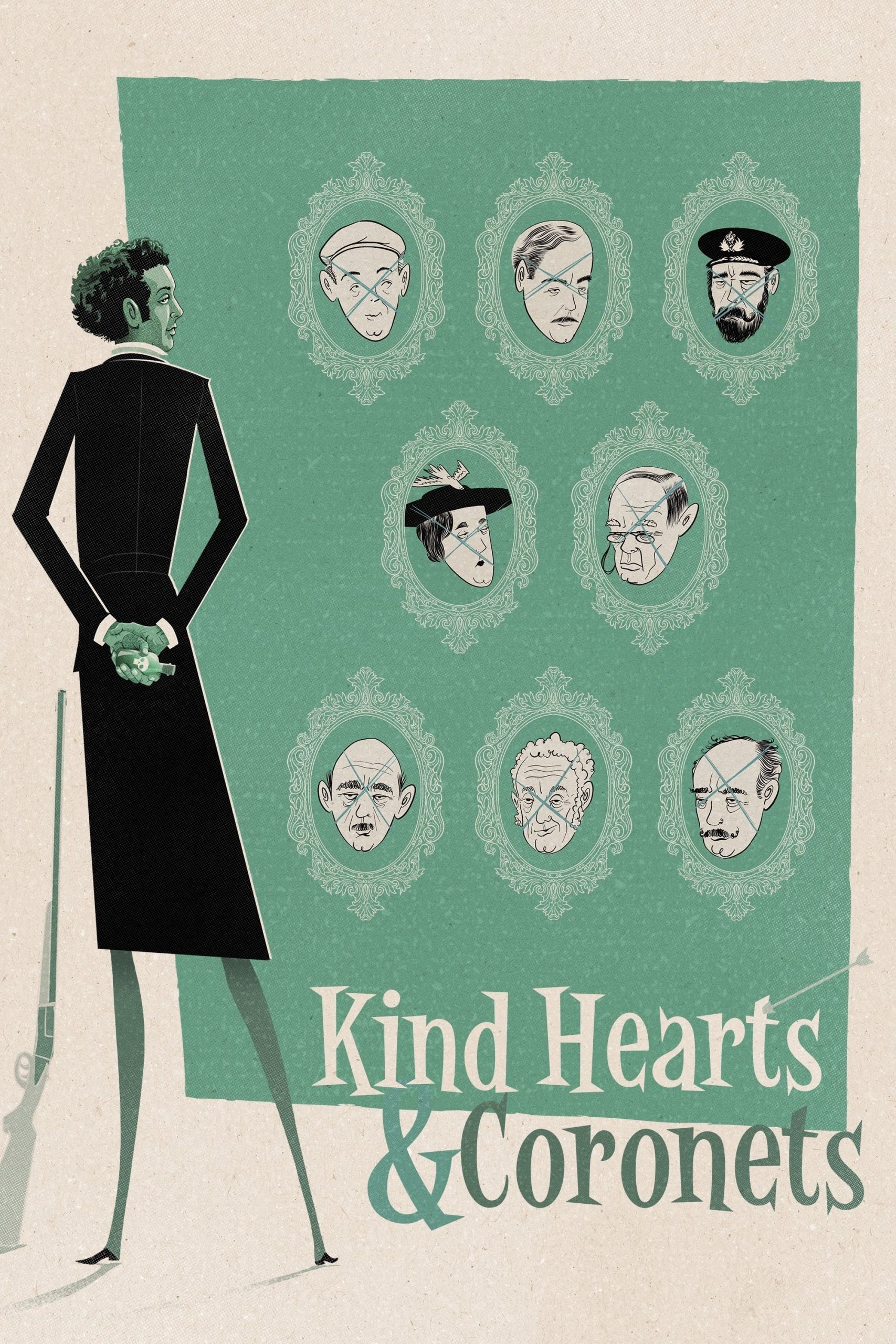
Whenever I revisit “Kind Hearts and Coronets,” I’m reminded just how meticulously crafted it is as an exemplar of black comedy. The film navigates the grotesque—not just with its plot, where a young man embarks on a methodical quest to erase an entire branch of his aristocratic family—but also in the way it invites the viewer to relish his schemes. I find myself complicit in the charm of Dennis Price’s performance, as Louis, whose inner monologue lays bare his aspirations—petty, grand, and deliciously vindictive. The humor never strives for belly laughs; instead, I’m treated to a symphony of barbed wit, spoken with a crispness and poise that feels distinctly British. That comedic restraint is what deepens the film’s darkness. It never shouts at me to find death amusing; it whispers, so I’m almost shocked when I catch myself smiling at a particularly droll line or murder method.
In the visuals, I see that very same sense of brittle refinement carried through—each setting brims with upper-crust grandeur, yet every glint of silver or slice of cake threatens to become a murder weapon. The stately homes, the meticulously set dinner tables, the elaborate costumes—they’re not merely background, but active components in the comedy’s arsenal. The refined surfaces contrast sharply with the protagonist’s cunning, constantly reminding me that evil often wears a civilized face.
The story’s structure is another reason I find it such an effective black comedy. The events are framed by Louis’s own voice—a move that pulls me directly into the mind of a killer, yet one whom I can’t help but like for his intelligence and clever phrasing. The sequence of deaths proceeds like a darkly comic dance; the tension of anticipation is built into the very order of the film’s storytelling. For me, there’s a delicate balance between rooting for Louis’s success and marveling at the audacity of his pursuit.
Characterization here is a masterclass in the genre’s signature style. Alec Guinness’s legendary performance as not one but eight members of the d’Ascoyne family is a comedic marvel, but it’s more than just a showcase of mimicry. Each victim is an exaggerated portrait that pokes at British class snobbery, eccentricity, and stubbornness. Through Guinness’s many faces, I see how black comedies often use caricature—never broad or cruel, but just enough to keep me at an amused, analytical distance from the violence. At the same time, Louis’s own arc resists neat moralizing: the film refuses to punish or reward him in conventional ways, mirroring the genre’s fondness for pesky moral ambiguity.
Other Essential Films in This Genre
- The Ladykillers (1955) – I remember watching this and being struck by its ability to turn a gang of criminals and their gentle landlady into the center of a farcical nightmare, full of ironic reversals. The way Ealing Studios handled criminal incompetence paired with old-fashioned English manners always made me laugh more nervously than any American caper ever did.
- Dr. Strangelove or: How I Learned to Stop Worrying and Love the Bomb (1964) – For me, Stanley Kubrick’s masterpiece pushes the black comedy genre further by taking an existential threat—nuclear annihilation—and treating it with a satirical coolness I find both horrifying and uproarious. Its deadpan performances and dialogue show how the genre can handle even the gravest topics without descending into despair.
- Arsenic and Old Lace (1944) – I have always admired how this American classic, while a little broader in comedic style, shines as black comedy in its portrayal of two kindly aunts who have turned murder into a charitable hobby. The collision between innocent appearances and dark actions is at the heart of what I think makes the genre so compelling.
- The Death of Stalin (2017) – Recent films like this show me that black comedy is alive and thriving. Watching political intrigue and historical atrocity transformed into a series of absurdist power plays—and finding myself laughing—reinforces my belief in the genre’s power to critique authority and human folly through laughter laced with unease.
Why This Genre Continues to Endure
From my own experience, black comedy functions almost as a form of social therapy. I sense that audiences, myself included, return to this genre because it offers the relief of laughter in places we aren’t normally supposed to laugh. When faced with bureaucracy, class structures, or the everyday injustices of life, black comedy gives us space to acknowledge how arbitrary and awkward the rules of society can be. I think the genre’s endurance lies in its ability to transform anxiety or dread into something manageable—by making a joke of the things we fear or despise, it provides a safe place to confront them while keeping us emotionally engaged.
I’m always amazed by how even older films in this genre retain their bite. The wit may be tailored to the manners and politics of their era, but I see that the human drives underlying black comedy—ambition, rivalry, hypocrisy—don’t really change with time. Audiences recognize themselves in the absurdity and darkness, and perhaps they gain a little wisdom or humility along the way. In viewing something like “Kind Hearts and Coronets,” I feel not only entertained but also oddly unburdened, as if seeing my own secret indignities and ambitions mirrored and gently mocked.
That’s why I keep coming back to black comedy: for the cleverness, but also for the sheer psychological freedom it offers. It shakes the foundations, politely, and asks whether decorum is any match for desire or folly. And as long as those contradictions exist—inside us and around us—I believe the genre will continue to delight, provoke, and endure.
If you’re interested in how viewers respond beyond technique, you may want to explore audience and critical reception.
🎬 Check out today's best-selling movies on Amazon!
View Deals on Amazon