
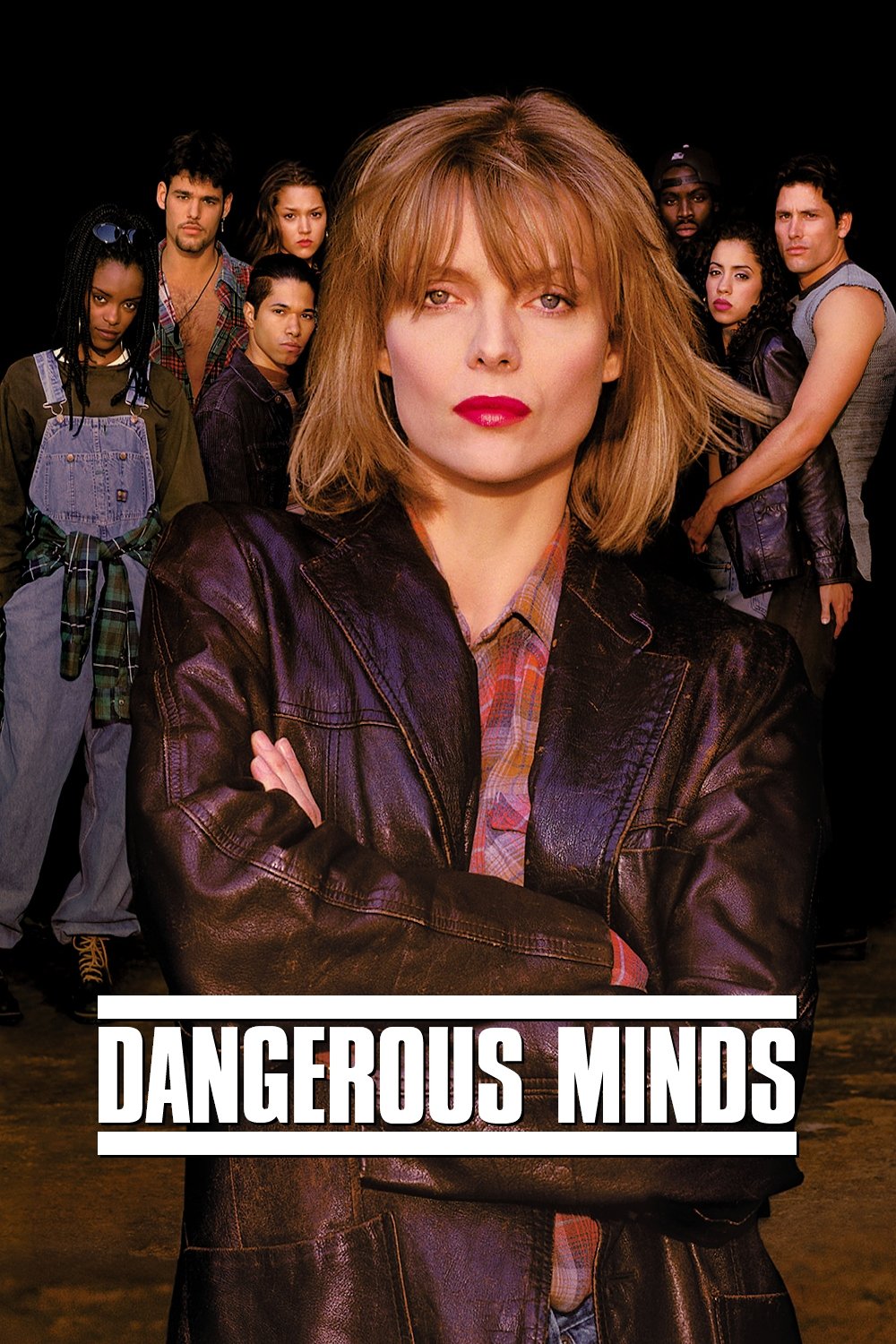
Film Movement Context
Watching Dangerous Minds, I could never reduce the experience to just another feel-good classroom drama. Right away, I sensed it belonged to a broader, far more turbulent cinematic lineage: the social problem film, grafted directly onto the roots of the American urban realism movement that flourished from the 1980s through the 1990s. To me, the film is a crystallization of the “teacher-in-transition” subgenre, where education and institutional failure are filtered through a deeply personal lens. I feel it connects most profoundly with the hybridization of the social issue drama and post-New Hollywood realism, a fusion that shaped not only the aesthetics but the politics of a generation’s filmmaking. The style – alternating grainy classroom intimacy with slick Hollywood beats – is a direct descendent of movies that confronted inner-city life with gritty honesty, while still empowering protagonists (often white outsiders) as disrupted saviors. But what seizes me most is how Dangerous Minds so clearly situates itself between the tail end of socially-engaged Hollywood and the emergent trend of “urban educator as redeemer” narratives, both emblematic and subversive within American cinema.
Historical Origins of the Movement
Tracing back the origin of this movement, I always land somewhere between post-World War II social problem films and the more urgent, immersive urban realism that emerged in the late 1970s and matured during the 1980s. I’m always struck by how Hollywood, during its Golden Age, only cautiously addressed systemic issues, usually through melodrama or one-dimensional moralizing. However, the late 1960s upended those conventions, allowing social and urban spaces to finally be examined with far less mediation and far more discomfort. The urban crisis – deindustrialization, racial tension, the explosion of drug epidemics, the collapse of traditional classrooms – isn’t just background, but becomes the battleground.
When I peel back the layers, I see a narrative lineage running from Sidney Poitier’s To Sir, With Love (1967), through the bombast of Lean on Me (1989), and eventually to the almost documentary-style immersion of Boyz N the Hood (1991) and Menace II Society (1993). These works, especially during the Reagan and post-Reagan years, sprang from artists responding with urgency to the widening chasm between American ideals and the real, embattled urban classroom. The period witnessed social problem films shedding their sanitized gloss and adopting the language, visuals, and sensibilities of expanding independent and urban cinema cultures. I believe Dangerous Minds stands as a pivotal node – at once absorbing the energy of contemporaneous Black urban narratives and transposing society’s anxieties about race, class, and education into a Hollywood-viable format. The movement did not spring up overnight; it was forged from decades of frustration, hope, and resistance within the urban American landscape, now refracted through the lens of the education system itself.
This Film’s Contribution to the Movement
Every time I revisit Dangerous Minds, I’m reminded how it uniquely toggles between blunt realism and stylized aspiration. While it was marketed on the back of Michelle Pfeiffer’s star power and Coolio’s anthemic soundtrack, what really compels me is how the film energetically spotlights the collision of lived urban realities with the performative optimism of American pop cinema. I see Dangerous Minds as testing the limits of the “outsider as liberator” trope – wielding its fictionalized teacher, LouAnne Johnson, as both a bridge and an agent of contradiction. Johnson’s outsider status, for me, rarely exits the realm of white savior narrative, but the film complicates that archetype by oscillating between genuine institutional critique and Hollywood’s commercial imperatives.
I have noticed that the film excels when it refuses to sanitize: its depiction of trauma, systemic violence, and classroom politics carries an unease and directness that feels like a direct inheritance from urban realism. However, just as frequently, I sense the pull of Hollywood orthodoxy tugging against that authenticity – moments of transformation and triumph are dialed up for emotional catharsis, sometimes at the expense of nuance. But perhaps that tension is the film’s principal contribution. Dangerous Minds does not shy away from showing the fracturing effect of racism and neglect, nor does it comfortably resolve those disparities. In this way, the movie both preserves and presses against the conventions of the movement it inhabits; it is as much a critique of white savior storytelling as it is a submission to it, and I always find myself both unsettled and galvanized by that.
Through my analysis, I continually return to the film’s textures: handheld camera work, diegetic noise, and the use of contemporary hip-hop, all wrapping the classroom in an aura of gritty immediacy. This aesthetic, when coupled with the emotionally-charged monologues and classroom confrontations, channels the urban realism movement’s disregard for polite, surface-level sentiment. Johnson’s relationship with her students always strikes me as emblematic of American cinema’s ongoing struggle to both confront and comfort – a thematic duality that, in my estimation, is what keeps the film’s legacy alive within the movement.
Influence on Later Genres and Films
- Inspiring the Modern Urban Teacher Narrative – When I watch later films like Freedom Writers (2007) or Coach Carter (2005), it’s impossible not to trace their narrative DNA back to Dangerous Minds. The way these films orchestrate the idealistic outsider’s clash with hardened, marginalized youth echoes not just the content but the stylistic choices of Dangerous Minds. I see a direct line in how these movies utilize dynamic classrooms, rapid-fire dialog, and music video-style editing to inject urgency and relatability. For me, Dangerous Minds made the “battlefield classroom” visually exciting while still acknowledging deeper systemic failures, something the next wave of urban educator films tried to emulate, with varying degrees of sincerity.
- Formalizing the Hip-Hop Classroom Aesthetic – One cannot overstate the symbolic power of “Gangsta’s Paradise” in the film’s marketing and in its worldbuilding. The soundtrack doubled as an aesthetic statement: the lived experience of students is filtered through hip-hop’s storytelling register. I perceive that later films and television shows, such as Empire and Atlanta, benefitted from this groundwork, normalizing not just hip-hop as a musical form but as a cinematic language. The film introduced a pipeline for Black urban culture to interface with mainstream Hollywood, even if that relationship was often fraught or commodified. This hybridization, as I experience it, gave permission to future filmmakers to deploy popular music as both narrative and sociological device within youth-oriented dramas.
- Fueling Debates About Race, Representation, and Authority – Rewatching Dangerous Minds through today’s lens, what stands out most is its catalyzing effect on debates around cultural representation and institutional authority in mainstream cinema. The film sits on the fault line of controversy regarding white savior narratives; I have witnessed it invoked both as a cautionary example and as a well-meaning, if inflected, attempt to grapple with race and privilege. This layered reception undoubtedly informed the ways subsequent films and shows like The Wire or Pose approach the question of agency, community self-representation, and who gets to tell the story of marginalized communities. I believe Dangerous Minds jumpstarted these necessary conversations in both industry and academic circles, making it impossible to ignore the problematic complexities of authority figures mediating the urban experience.
The Movement’s Lasting Impact
I never leave a screening of Dangerous Minds without feeling the aftershocks of the movement it represents. For me, the American urban realism and social problem film tradition has never been just about exposing injustice for its own sake – it is about laying bare the conflicts, contradictions, and sometimes false hopes inherent to our culture’s struggles with race, class, and institutional neglect. Even as new filmic paradigms arise, I have found that the legacy of this movement lingers in the ways narratives about marginalized spaces, especially classrooms, are approached – with caution, with courage, and with constant negotiation between truthfulness and Hollywood abstraction. The movement matters because it forced open the cinematic conversation about whose voices are centered, how authenticity can clash with accessibility, and what responsibilities film has toward its subjects. Every time I revisit Dangerous Minds, I am reminded that these debates are still alive and unresolved, giving the movement a persistent urgency and resonance far beyond the era in which it flourished.
To connect style and technique with broader context, you may find these perspectives useful.
🎬 Check out today's best-selling movies on Amazon!
View Deals on Amazon